
A Timeless Perspective: From Ansel Adams to Chicago Commercial Photography
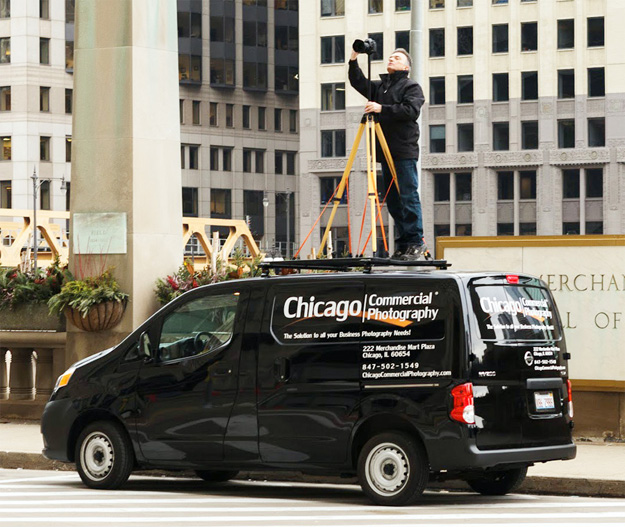
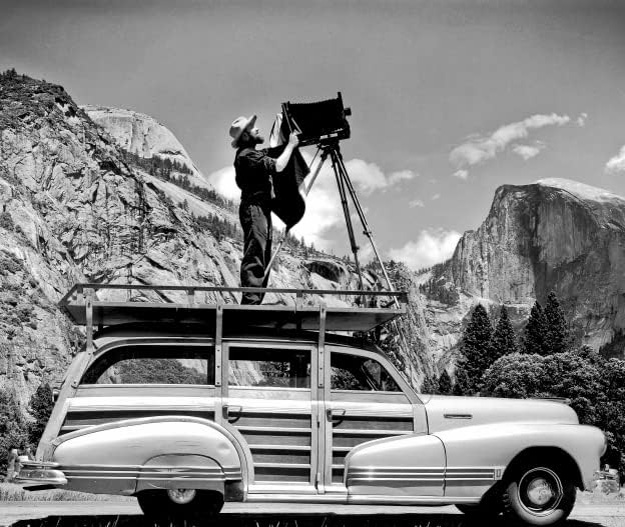
While our vehicle platform is inspired by Ansel Adams’ legendary setup, our goals are uniquely different. Adams used his elevated platform to capture the sweeping, untamed scale of the American wilderness, rising above the brush to find a clear line of sight to a mountain peak.
For us, that same elevation is a critical tool for architectural photography. In an urban environment like Chicago, a few extra feet of height changes everything. It allows us to clear street-level 'noise'—like parked cars, traffic, and pedestrians—while squaring our camera with the building's facade. This higher vantage point reduces 'keystoning' (the tilting effect seen in tall buildings) and allows us to capture the true geometry and grandeur of a structure, just as the architect intended.
Ansel Adams' Mobile Studio
In the mid-20th century, Ansel Adams, a master of landscape photography, modified his circa 1947–48 Pontiac Streamliner woody wagon into a mobile darkroom and camera platform. This innovative setup allowed him to minimize foreground distractions and capture the majestic, expansive views of the American West that became his signature style. Famously, the height he gained from this mobile perch was critical in achieving the precise angle needed for his iconic "Moonrise, Hernandez, New Mexico" photograph in 1941.
Chicago Commercial Photography Mobile Studio Today
While our rooftop platform shares the same silhouette as Ansel’s, the technology inside the vehicle is pure 21st century. Unlike the days of film where the results were a mystery until the darkroom, our truck functions as a mobile digital suite.
Through a tethered system, high-resolution files are transferred seamlessly from the rooftop camera to a workstation inside the truck. This allows us to evaluate, zoom, and even perform preliminary edits on the spot. Because we can monitor the live feed from the comfort of the cabin, we can fine-tune the truck’s position inch-by-inch to find the perfect 'hero shot' angle. For our clients, this means total certainty: we don’t leave the site until we know we’ve captured the perfect architectural perspective.
Are you wondering about the wooden tripod?
Learn the
secret behind it here
Architectural & Commercial Photography: Frequently Asked Questions